Let’s get one thing out of the way: this isn’t for people who already know what a superset is, or who own a foam roller, or who talk about “leg day” unprompted.
This is for the guy who hasn’t done a structured workout since college. Who tried a gym membership once, went four times, and quietly let it die. Who has 15 minutes most evenings, a living room, and zero desire to learn a complicated routine after a 10-hour workday.
If that’s you — good. This is built for exactly that person.
Why most “beginner” workouts fail before they start
Most fitness content isn’t actually written for beginners. It’s written by people who forgot what beginner feels like. So you get 45-minute routines, gym jargon, and 12 exercises that need a diagram to understand.
Your brain, at 8 PM after work, does not have the bandwidth to decode any of that. So the plan dies in a browser tab, and you feel a little worse about yourself for it.
The fix isn’t willpower. It’s a plan small enough to survive a tired Tuesday.
The rule: one movement per body area, nothing else
A full-body workout doesn’t need 12 exercises. It needs 4-6, one for each major area, done with enough consistency that your body actually adapts. That’s it.
Here’s a beginner full-body routine you can do in your living room, no equipment required to start:
1. Squats — legs and core Stand, feet shoulder-width apart, lower like you’re sitting into a chair, stand back up. 8-10 reps.
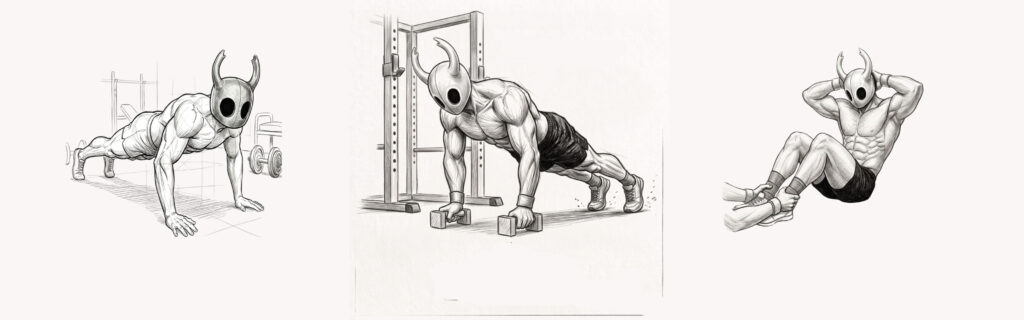
2. Push-ups (or wall push-ups if needed) — chest, shoulders, arms Full push-up if you can, wall or knee version if you’re starting out. No shame in the modified version — it’s still working the same muscles. 6-10 reps.
3. Glute bridges — lower back and glutes Lie on your back, knees bent, lift your hips up, squeeze, lower slowly. 10-12 reps. This one directly counters the stiffness from sitting all day.
4. Plank — core Hold a forearm plank. Start at 15-20 seconds. That’s genuinely enough to begin.
5. Standing back extensions — spine mobility Stand tall, hands on lower back, gently lean back a few inches, hold 2 seconds, return. 8 reps. This one is quietly the most important move for anyone with a desk job.
Do this as 2 rounds, resting a minute between rounds. Total time: 12-15 minutes.
Why this works better than a “proper” plan right now
You don’t need progressive overload calculations in week one. You need to prove to yourself that you can start and finish something. That’s the entire win of week one — not fat loss, not visible muscle, just showing up and completing 12 minutes.
The physical benefits — less stiffness, slightly better sleep — usually show up within the first 1-2 weeks. That’s your early proof it’s working, long before any visible change in the mirror.
What to do when you miss a day (because you will)
You will skip a day. Maybe several. That’s not the plan failing — that’s normal. The only mistake is treating one missed day as proof it’s not for you and quitting entirely.
The move is simple: whenever you remember, you just start the next session as if the gap didn’t happen. No make-up sessions, no guilt tax. Consistency beats a perfect streak every time.
Where equipment comes in later, not first
You don’t need equipment to start this routine — bodyweight is enough for the first few weeks. As squats, push-ups, and bridges get easier, that’s usually the point where light resistance (bands, adjustable dumbbells, a bench) starts making sessions more effective again, without adding time or complexity.
But that’s a week 3-4 conversation. Right now, the only job is: do the 12 minutes, three or four times this week, in your own living room, before the day fully takes over.