One Kettlebell, 15 Minutes: The Only Home Workout Guide You Need to Start
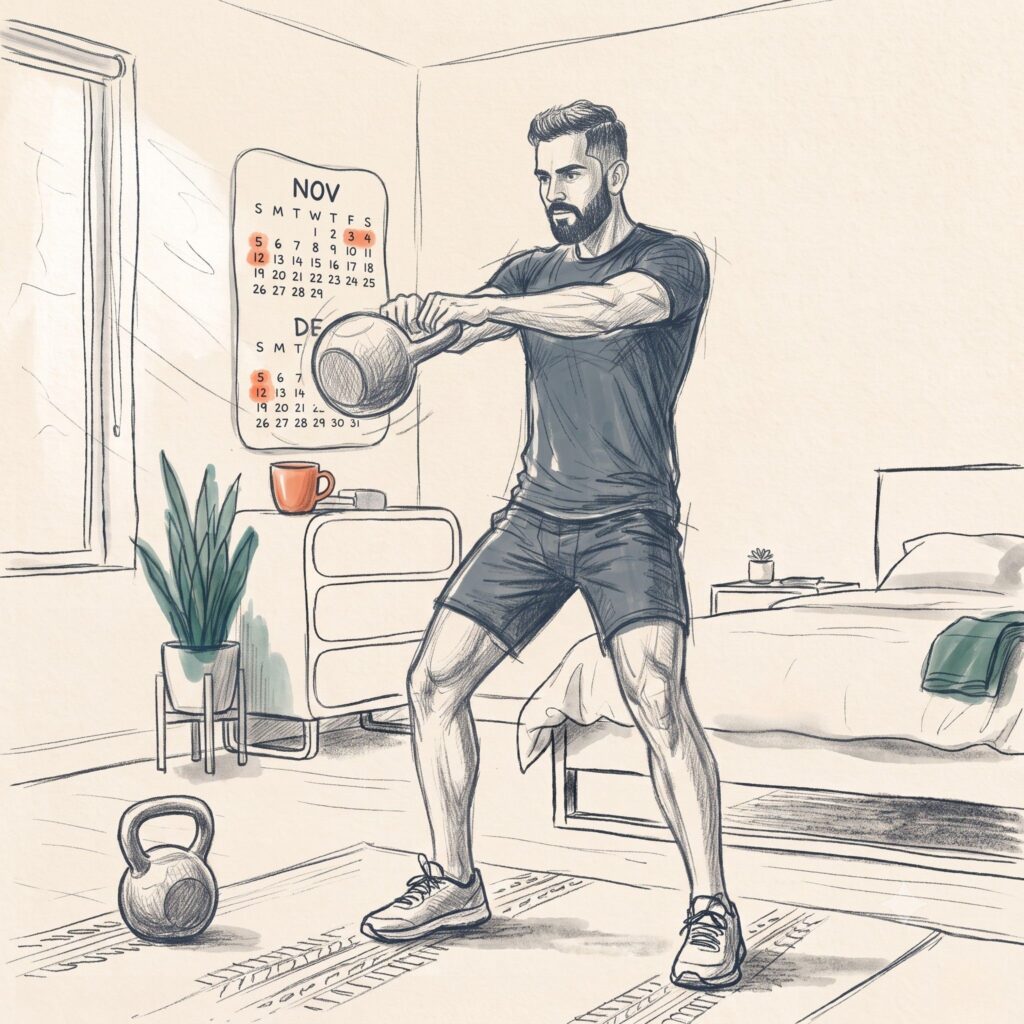
Written by: Himan, Founder’s Note Contributor at homegymlab Last updated: July 25, 2026
Disclaimer: This article is for general informational purposes and is not a substitute for professional medical advice. If you have an existing back, joint, or heart condition, consult a doctor before starting any new exercise routine.
There’s a specific kind of relief in a kettlebell: no assembly manual, no bolts to tighten, no wondering where a piece goes. You take it out of the box, and it is ready to use. For someone who has already spent all day solving complicated problems at work, that matters more than it sounds.
If you have been doing bodyweight basics for a few weeks (squats, push-ups, bridges) and they have started feeling easy, a kettlebell is the natural next step. One piece of equipment, one corner of your living room, and a workout that is finished before your tea gets cold.
This guide covers everything: why a kettlebell works for a busy schedule, the exact moves with full setup and form cues, a 4-week progression plan, common mistakes, safety notes, and a section answering the questions most beginners have before they start.
Table of Contents
- Why a kettlebell (and not a dumbbell rack)
- Before you start: warming up in under 3 minutes
- The core workout: 4 moves, full instructions
- How to choose the right weight
- A 4-week beginner progression plan
- Common mistakes and how to fix them
- Recovery, soreness, and when to rest
- The trust question nobody says out loud
- Related questions
1. Why a kettlebell (and not a dumbbell rack)
A dumbbell setup works, but it usually means multiple weights, a rack, and more floor space than most Bengaluru apartments comfortably offer. A single kettlebell, sized to your current strength, covers a full-body workout on its own, because of how its weight sits off-center from the handle. That off-center load forces your core, back, and grip to engage on almost every move, not just the muscle you are targeting.
The practical result: fewer pieces of equipment, comparable results to a small dumbbell set, and far less clutter to explain to your family when they ask what that heavy black ball is doing in the living room.
Kettlebells also transfer well to real life. The hip-hinge pattern you train in a kettlebell deadlift or swing is the same movement pattern you use picking up a suitcase, your child, or a grocery bag off the floor. Training it deliberately, with control, is part of what protects your lower back outside the workout too.
2. Before you start: warming up in under 3 minutes
Skipping the warm-up is the single most common beginner shortcut, and it is the one that leads to strains. You do not need a long routine, just enough to raise your heart rate slightly and wake up the muscles you are about to load.
Warm-up (2-3 minutes total):
- 20 seconds of marching in place, lifting knees comfortably high
- 10 bodyweight squats, slow and controlled
- 10 hip circles each direction, hands on hips
- 10 arm circles each direction, gradually increasing size
This is not meant to tire you out. It is meant to prepare your joints, especially your hips and lower back, for the loaded movements that follow.
3. The core workout: 4 moves, full instructions
You do not need ten kettlebell exercises. You need a few done properly, on repeat, with attention to form.
Move 1: Kettlebell Deadlift (legs, lower back)
Setup: Stand with feet hip-width apart, kettlebell on the floor between your feet, roughly in line with your shoelaces.
Execution: Push your hips back as you bend down to grip the handle with both hands, keeping your back flat, not rounded. Your shins should stay close to vertical. Drive through your heels to stand up tall, squeezing your glutes at the top. Reverse the motion with control to lower it back down.
Breathing: Inhale on the way down, exhale as you stand up.
Reps: 8-10
Why it matters: This single move retrains your hips and lower back to move the way they are supposed to, which is the exact pattern that erodes after years of sitting all day.
Move 2: Kettlebell Goblet Squat (legs, core)
Setup: Hold the kettlebell close to your chest with both hands, cupping the horns (the sides of the handle) or the bell itself.
Execution: Keep your chest up and your elbows tucked close to your ribs. Squat down by pushing your hips back and bending your knees, going as low as feels comfortable while keeping your heels flat on the floor. Stand back up by driving through your heels.
Breathing: Inhale on the way down, exhale as you rise.
Reps: 8-10
Why it matters: Holding the weight at your chest naturally encourages an upright torso, which is a helpful counter to the forward-hunched posture of a desk job.
Move 3: Kettlebell Row (back, shoulders)
Setup: Place one hand on a sturdy chair or table for support, hinge forward at the hips so your torso is roughly parallel to the floor, and hold the kettlebell in your free hand, arm hanging straight down.
Execution: Pull the kettlebell up toward your ribs, leading with your elbow, squeezing your shoulder blade at the top. Lower it back down with control until your arm is fully extended again.
Breathing: Exhale as you pull, inhale as you lower.
Reps: 8-10 per side
Why it matters: This directly strengthens the muscles between your shoulder blades that spend all day being stretched and weakened by a rounded, screen-facing posture.
Move 4: Kettlebell Swing (full body, conditioning)
Setup: Stand with feet slightly wider than shoulder-width, kettlebell on the floor a short distance in front of you.
Execution: Hinge at your hips to grip the kettlebell, then hike it back between your legs like a football snap. Drive your hips forward explosively to swing the kettlebell up to roughly chest height, letting the power come from your hips and glutes, not your arms or shoulders. Let it swing back down naturally and repeat the hip hinge for the next rep.
Breathing: Exhale sharply as you drive your hips forward, inhale as it swings back.
Reps: 10-12
Why it matters: This is the single move that delivers the most in the least time: legs, back, shoulders, grip, and heart rate, all in one repeated motion.
Putting it together
Perform the four moves back-to-back as one round, resting briefly between exercises if needed. Complete 2-3 rounds total, resting 60-90 seconds between rounds.
Total time: 15-18 minutes.
4. How to choose the right weight
The most common beginner mistake is not picking too light. It is picking too heavy, usually to prove something in week one. Choose a weight where the last 2 reps of each set feel firm but controlled, not shaky or rushed.
As a general starting range for beginners in the 40-45 age bracket:
- Swings and deadlifts: 8-12 kg
- Goblet squats: 6-8 kg
- Rows: 6-8 kg
These are starting points, not fixed rules. You can always increase weight later as the movements become easier. You cannot undo a strained lower back from starting too heavy.
5. A 4-week beginner progression plan
| Week | Frequency | Rounds | Focus |
|---|---|---|---|
| Week 1 | 2 sessions | 2 rounds | Learning the movement patterns, lighter weight |
| Week 2 | 3 sessions | 2 rounds | Same weight, focus on smoother form and breathing |
| Week 3 | 3 sessions | 3 rounds | Add one round, weight stays the same |
| Week 4 | 3-4 sessions | 3 rounds | Increase weight slightly if reps feel easy |
The goal in the first two weeks is not intensity. It is proving to yourself that you can start and finish the session consistently. Everything else builds on that foundation.
6. Common mistakes and how to fix them
Rounding the back during the deadlift or swing: This is the most common and the most important one to fix. If your lower back rounds, the weight is either too heavy or your hips are not hinging properly. Lighten the load and practice the hip hinge with no weight first.
Squatting too shallow out of fear: Beginners often stop the goblet squat far too early out of caution. As long as your heels stay flat and your back stays neutral, going lower is safe and more effective.
Using arms instead of hips in the swing: The kettlebell swing is a hip movement, not a shoulder movement. If your arms feel tired after swings, you are likely muscling the weight up instead of driving it with your hips.
Holding your breath throughout: Holding your breath spikes blood pressure unnecessarily. Match your breath to the movement as described above.
7. Recovery, soreness, and when to rest
Mild muscle soreness for 1-2 days after your first few sessions is normal and is not a sign of injury. Sharp pain during a movement, or pain that gets worse rather than better over a few days, is different and is a signal to stop and reassess, or check with a doctor if it persists.
Sleep and basic hydration matter more for recovery than people expect. Most beginners notice reduced stiffness and better sleep within the first 1-2 weeks of consistent sessions, well before any visible physical change.
8. The trust question nobody says out loud
Before buying anything, the real question in your head is usually some version of: will this actually get used, or will it become an expensive corner decoration?
That is a fair question, and the honest answer is that it depends on the plan, not the product. A kettlebell sitting in the corner does nothing on its own. A kettlebell attached to a 15-minute, 4-move routine you already know by heart is the difference between equipment that gets used and equipment that gets forgotten.
That is why this routine is deliberately short, repeatable, and fully written out above. You should not need to figure out your workout each evening. You should be able to do the same four moves, get slightly better each week, and leave the thinking for your actual job.
9. Related questions
How often should a beginner do kettlebell workouts? 2-3 sessions a week is a solid starting frequency, with at least one rest day between sessions in the first few weeks to allow your body to adapt.
Can kettlebell training help with back pain from sitting all day? Movements like the deadlift, row, and standing hip hinge patterns directly strengthen the muscles that counteract prolonged sitting. Many beginners report reduced stiffness within the first couple of weeks, though persistent or severe back pain should be evaluated by a doctor first.
Do I need more than one kettlebell to start? No. A single kettlebell of the appropriate weight is enough to perform a complete full-body routine. A second, lighter or heavier kettlebell becomes useful later as you progress different movements at different loads.
Is 15 minutes actually enough for a real workout? Yes, provided the session uses compound movements like the ones above, which engage multiple muscle groups at once rather than isolating one small muscle per exercise. Consistency across the week matters more than the length of any single session.
What if I miss a few days or weeks? Simply resume the plan from wherever you left off. There is no need for makeup sessions or to restart from week one. Consistency over time matters more than an unbroken streak.
About the Author
Himan writes about home fitness for people who do not have time to waste on complicated routines. His own path started with a personal transformation of going from 70kg to 58kg using home workouts alone, with no gym membership and no personal trainer, which shapes the practical, no-nonsense approach in everything published on homegymlab.
This article was reviewed for exercise safety and form accuracy by a certified strength and conditioning specialist. Always consult a healthcare professional before beginning a new exercise program, particularly if you have pre-existing back, joint, or cardiovascular conditions.