Written by: Himan, Founder’s Note Contributor at homegymlab Last updated: August 10, 2026
Disclaimer: This article is for general informational purposes and is not a substitute for professional medical or nutritional advice. If you have an existing heart, joint, or metabolic condition, consult a doctor before starting any new exercise routine.
If you have ever searched “best fat burning workout” at 11 PM, tired, phone brightness turned down so you do not wake anyone, you already know the problem: most results promise a lot and explain very little. Ninety-minute programs. Supplement stacks. Workouts that assume you have a gym, a trainer, and two free hours a day.
You have none of those. You have maybe 20 minutes, a living room, and a body that used to look and feel different than it does now.
This guide skips the noise. It explains what actually drives fat loss, gives you one workout you can do at home in under 20 minutes, and tells you honestly what to expect and when.
Table of Contents
- What actually burns fat (and what does not)
- Why short, intense workouts outperform long, slow ones for busy schedules
- The 20-minute fat-burning circuit
- What to eat around this (without a diet overhaul)
- A realistic 4-week expectation timeline
- Common mistakes that stall results
- Related questions
1. What actually burns fat (and what does not)
Fat loss ultimately comes down to a sustained calorie deficit, meaning your body burns more energy than you take in, over time. No single workout “melts” belly fat directly. Spot reduction, the idea that specific exercises burn fat from a specific area, is not how the body works.
What exercise does very well is create that deficit efficiently, preserve or build the muscle that keeps your metabolism active, and in the case of intense workouts, keep your body burning slightly elevated calories for hours after you are done training. That last effect has a name: excess post-exercise oxygen consumption, or EPOC. It is one reason short, intense sessions can be more time-efficient for fat loss than long, slow ones.
2. Why short, intense workouts outperform long, slow ones for busy schedules
A 60-minute slow jog and a 20-minute intense circuit can burn a comparable number of total calories once you account for the after-burn effect of the intense session. For someone with 20 minutes to spare, not 60, this matters enormously.
Intensity, not duration, is the lever you actually have available. A short circuit that keeps your heart rate elevated throughout, using full-body compound movements, gets you most of the benefit of a long cardio session in a fraction of the time.
3. The 20-minute fat-burning circuit
This circuit alternates strength and conditioning movements to keep your heart rate up throughout, without needing any equipment to start. If you already have a kettlebell or a pair of dumbbells, a version with light resistance is noted below each move.
Format: 40 seconds of work, 20 seconds of rest, for each move. Complete the full circuit of 6 moves, rest 1-2 minutes, then repeat for a second round.
1. Squat to reach (legs, core, shoulders) Squat down, then as you stand, reach both arms overhead. Keeps your heart rate up while working your whole lower body. With a kettlebell: hold at chest height as a goblet squat, no overhead reach needed.
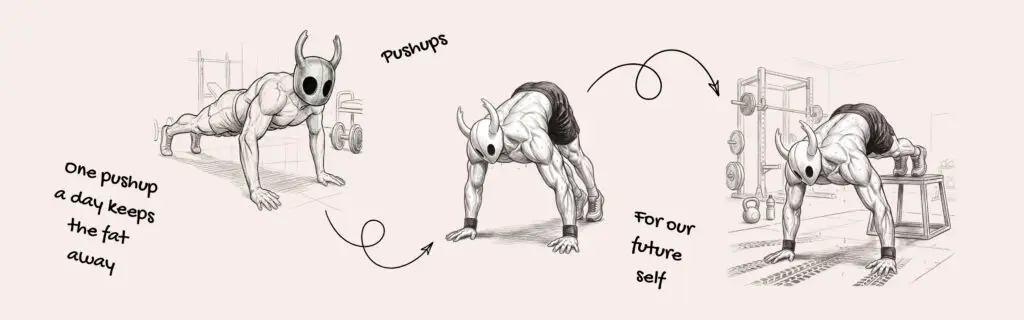
2. Push-up to shoulder tap (chest, arms, core) Perform a push-up, then at the top, tap your opposite shoulder with each hand alternately. Use knee push-ups if needed.
3. Reverse lunges, alternating (legs, glutes) Step back into a lunge, alternating legs each rep. Keep your torso upright. With a kettlebell: hold it at your chest for added resistance.
4. Mountain climbers (core, conditioning) In a plank position, drive your knees toward your chest alternately at a controlled, sustainable pace.
5. Standing back extensions (spine, posture) Stand tall, hands on lower back, gently lean back a few inches, hold briefly, return. Slower and more controlled than the other moves, used here as an active recovery move that still counters desk posture.
6. Kettlebell swings or standing high knees (full body, conditioning) If you have a kettlebell, this is the highest-output move in the circuit. If not, standing high knees at a brisk pace covers the same conditioning role.
Total time: roughly 20 minutes including rest periods, for 2 full rounds.
4. What to eat around this (without a diet overhaul)
Exercise creates the deficit more efficiently, but food remains the larger lever in fat loss. You do not need a complicated diet plan to make progress. A few practical, sustainable habits tend to matter more than any specific diet:
- Prioritize protein at each meal (dal, eggs, paneer, chicken, fish, or plant-based protein), which supports muscle retention while in a deficit
- Reduce, rather than eliminate, heavily processed and fried foods, especially the ones that tend to appear during long work hours or late-night stress eating
- Keep hydration consistent through the day, since mild dehydration is often mistaken for hunger
This is not a strict diet, and it does not need to be. Small, sustainable shifts held consistently outperform aggressive short-term restriction almost every time. If you want a structured nutrition plan, that is worth discussing with a doctor or a registered dietitian rather than following generic online advice.
5. A realistic 4-week expectation timeline
Week 1-2: Reduced stiffness, slightly better sleep, and mild improvement in daily energy. Visible fat loss is usually not noticeable yet, and that is expected and normal.
Week 3-4: With 3-4 sessions a week and consistent eating habits, most people begin noticing slightly looser clothing fit, particularly around the waist, before it becomes visually obvious in the mirror.
Beyond week 4: Progress becomes more visible with continued consistency, and this is typically when a slight increase in workout intensity or added resistance (light dumbbells or a kettlebell) helps continue driving results.
Progress in the first month is felt before it is seen. That order is normal, not a sign that it is not working.
6. Common mistakes that stall results
Trying to do this every single day: Recovery is part of the process, not the absence of it. 3-4 sessions a week with rest days built in outperforms daily sessions that lead to burnout by week two.
Judging progress only by the scale: Weight can fluctuate daily due to water, sodium, and sleep. Clothing fit and energy levels are often more reliable early indicators than the number on a scale.
Chasing a longer workout instead of a harder one: Extending this circuit to 40-60 minutes at low intensity is generally less effective for fat loss than keeping it short and intense, given a fixed amount of available time.
Ignoring sleep: Poor sleep directly affects hunger hormones and recovery. A short workout paired with 5 hours of sleep will underperform a short workout paired with consistent, adequate sleep.
7. Related questions
How many days a week should I do this fat-burning workout? 3-4 sessions a week, with at least one rest day between sessions, is a sustainable starting frequency for most beginners.
Can I really lose belly fat without going to a gym? Yes. Fat loss is driven primarily by a consistent calorie deficit and overall activity level, not by gym access specifically. A structured home routine like this one, combined with reasonable eating habits, is enough to create meaningful change.
Is 20 minutes really enough, or do I need longer sessions? For fat loss specifically, intensity matters more than duration once a session crosses roughly 15-20 minutes of genuine effort. Longer sessions are not wasted, but they are not required to see results.
Do I need equipment for this workout to work? No. The circuit above is written to work entirely with bodyweight. A kettlebell or a pair of dumbbells adds resistance and can accelerate results once bodyweight versions start feeling easy, but they are not required to begin.
Why am I not seeing changes in the mirror yet after two weeks? This is expected. Internal changes such as improved energy, better sleep, and reduced stiffness typically arrive before visible physical changes, which usually take closer to 4-6 weeks of consistent effort to become noticeable.
About the Author
Himan writes about home fitness for people who do not have time to waste on complicated routines. His own path started with a personal transformation of going from 70kg to 58kg using home workouts alone, with no gym membership and no personal trainer, which shapes the practical, no-nonsense approach in everything published on homegymlab.
This article was reviewed for exercise safety and accuracy by a certified strength and conditioning specialist. Always consult a healthcare professional before beginning a new exercise or nutrition program, particularly if you have pre-existing health conditions.